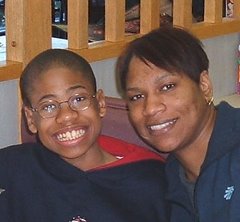
Racial Inequity in Special Education
Executive Summary for Federal Policy Makers
Since its passage in 1975, the IDEA has brought tremendous benefits: today, approximately six million children with disabilities enjoy their right to a free appropriate public education. The benefits of special education, however, have not been equitably distributed. Minority children with disabilities all too often experience inadequate services, low-quality curriculum and instruction, and unnecessary isolation from their nondisabled peers. Moreover, inappropriate practices in both general and special education classrooms have resulted in overrepresentation, misclassification, and hardship for minority students, particularly black children.
Full Article available at URL: http://www.civilrightsproject.harvard.edu/research/specialed/IDEA_paper02.php
The Civil Rights Project offers parents "action kits" to teach parents how to advocate for their children. This website is very useful.
For more information and resources on autism go to:
http://www.autismconcepts.com/.
Tuesday, March 01, 2005
Educating Children with Autism, Nat'l Academies of Science Report
The National Academies of Science wrote a report in 2001, "Educating Children with Autism" with their recommendations. They address this topic in detail. This report may be useful to parents in developing your child's Individualized Education Plan (IEP).
For example, the report reads at pg. 3 :
"The committee recommends that children with any autistic spectrum
disorder (autistic disorder, Asperger’s disorder, atypical autism, PDDNOS,
childhood distintegrative disorder), regardless of level of severity
or function, be eligible for special education services within the category
of autism."
The Educating Children with Autism report is made available free of charge as an Open Book at URL: http://www.nap.edu/books/0309072697/html/
For more information and resources on autism go to:
http://www.autismconcepts.com/.
For example, the report reads at pg. 3 :
"The committee recommends that children with any autistic spectrum
disorder (autistic disorder, Asperger’s disorder, atypical autism, PDDNOS,
childhood distintegrative disorder), regardless of level of severity
or function, be eligible for special education services within the category
of autism."
The Educating Children with Autism report is made available free of charge as an Open Book at URL: http://www.nap.edu/books/0309072697/html/
For more information and resources on autism go to:
http://www.autismconcepts.com/.


Minorities Get Inferior Care Even if Insured Study Finds
These news articles are based on a report, which reviewed more than 100 studies conducted over the last ten years. They are important to read about since the differences are said to to be pervasive and cuts across all conditions of health and across the entire country.
Other related articles:
Race Gap Seen in Health Care Of Equally Insured Patients
Full article available at URL:
http://query.nytimes.com/gst/health/article-page.html?res=9901E2DD1138F932A15750C0A9649C8B63
For information and resources on autism go to:
http://www.autismconcepts.com/.
Minorities Get Inferior Care Even if Insured Study Finds
March 21, 2002
By SHERYL GAY STOLBERG
WASHINGTON, March 20 - Racial and ethnic minorities in theUnited States receive lower quality health care than whites, even when their insurance and income are the same, say a panel of scientific experts who termed their study awake-up call to the nation's doctors.
Full article available at URL:
Other related articles:
Race Gap Seen in Health Care Of Equally Insured Patients
Full article available at URL:
http://query.nytimes.com/gst/health/article-page.html?res=9901E2DD1138F932A15750C0A9649C8B63
For information and resources on autism go to:
http://www.autismconcepts.com/.
Aid for autism
Aid for autism
By C. A. Garland and Brenda Harris
baltimoresun.com
January 25, 2005
While the approaches may be different, experts are united on several key aspects for treating autism, PDD and Asperger's. They are:
- Early intervention is better than late.
- More-intensive intervention is better than a go-slow approach (not simply to maximize the rate of learning, but to break bad habits such as repetitive, mechanical, unimaginative play and self-injurious action that usually cannot be schooled out of a child in just a couple of hours a day).
- Possibly half of all autistic children can recover enough to be mainstreamed in school, develop friendships, ultimately hold jobs and have good prospects of a normal life.
- Even those who cannot aspire to this standard of recovery can do much better than they would have without treatment.
Read Full Article at URL: http://www.baltimoresun.com/news/opinion/oped/bal-op.autism25jan25,1,1622664,print.story?coll=bal-oped-headlines
For more information and resources on autism go to:
http://www.autismconcepts.com/.
By C. A. Garland and Brenda Harris
baltimoresun.com
January 25, 2005
While the approaches may be different, experts are united on several key aspects for treating autism, PDD and Asperger's. They are:
- Early intervention is better than late.
- More-intensive intervention is better than a go-slow approach (not simply to maximize the rate of learning, but to break bad habits such as repetitive, mechanical, unimaginative play and self-injurious action that usually cannot be schooled out of a child in just a couple of hours a day).
- Possibly half of all autistic children can recover enough to be mainstreamed in school, develop friendships, ultimately hold jobs and have good prospects of a normal life.
- Even those who cannot aspire to this standard of recovery can do much better than they would have without treatment.
Read Full Article at URL: http://www.baltimoresun.com/news/opinion/oped/bal-op.autism25jan25,1,1622664,print.story?coll=bal-oped-headlines
For more information and resources on autism go to:
http://www.autismconcepts.com/.
"Talking About Medicare," New Online Guide
The Kaiser Family Foundation has released a new, online consumer guide, "Talking About Medicare," to help people on Medicare and their family members and caregivers to make informed decisions about their health care. "Talking About Medicare" helps to answer basic questions about Medicare eligibility and coverage. It also includes a chapter devoted to the new Medicare prescription drug law and its implications for consumers, including an overview of the Medicare-approved discount drug card program and the full Medicare prescription drug benefit, which will go into effect in 2006. The guide also explains supplemental insurance options, the Medicare Advantage program, and long-term care issues, and includes a state-by-state list of key agencies that can answer specific questions about Medicare, Medicaid, supplemental coverage, and long-term care.
The guide is available at http://www.kff.org/talkingaboutmedicare.
For more information and resources on autism go to:
http://www.autismconcepts.com/.
The guide is available at http://www.kff.org/talkingaboutmedicare.
For more information and resources on autism go to:
http://www.autismconcepts.com/.
A User-Friendly Vaccination Schedule
"A User-Friendly Vaccination Schedule," written by Dr. Donald Miller, cardiac surgeon and Prof. of Surgery at the Univ. of Washington, in Seattle. He writes various articles, such as "Mercury on the Mind", available at URL: http://www.lewrockwell.com/miller/miller14.html.
"A User-Friendly Vaccination Schedule" is available at URL: http://www.lewrockwell.com/miller/miller15.html.
Be sure your child's vaccines are thimerosal-free.
For a list of licensed vaccines in the U.S. that show Thimerosal content, please visit URL: http://www.vaccinesafety.edu/thi-table.htm.
For more information and resources on autism go to:
http://www.autismconcepts.com/.
"A User-Friendly Vaccination Schedule" is available at URL: http://www.lewrockwell.com/miller/miller15.html.
Be sure your child's vaccines are thimerosal-free.
For a list of licensed vaccines in the U.S. that show Thimerosal content, please visit URL: http://www.vaccinesafety.edu/thi-table.htm.
For more information and resources on autism go to:
http://www.autismconcepts.com/.
Subscribe to:
Posts (Atom)